Best Moss for Closed Terrarium: 7 Picks for 2026
Find the best moss for closed terrarium setups: seven species compared by humidity needs, light, growth speed, and looks, plus tips to match your design.
You've arranged the stones, pressed a beautiful patch of moss into the soil, and closed the lid. Then the glass stays foggy, the moss turns brown, and the miniature hillside starts slumping. Adding another spray of water seems reasonable, but it can make the problem worse.
A sealed terrarium isn't just a damp plant pot. It's a small enclosure where light, moisture, temperature, and limited airflow have to work together. Choosing moss that looks right but needs different growing conditions can leave you fighting the jar instead of enjoying it.
The best moss for a closed terrarium is therefore the one that fits the enclosure you can provide. A small bottle needs a different growth habit from a roomy woodland tank, and a constantly wet surface calls for a different choice from a moist, raised mound. Healthy moss helps maintain a thriving environment, but it can't correct darkness or standing water.
These picks include Fountain Fissidens, Pincushion Moss, Bog Moss, Cypress-leaved Plait Moss, Java Moss, Fern Moss, and Rose Moss. They aren't equally suitable for every sealed jar. Some are sensible carpeting choices, some need more headroom, and the aquatic candidates deserve extra care when grown above water.
Choose for the conditions first. Then decide whether you want a soft carpet, rounded hills, or a miniature forest floor.
1. Fissidens fontanus (Fountain Fissidens)
Best for a persistently wet feature, rather than an ordinary soil carpet. Fountain Fissidens has finely divided, flattened shoots that make an attractive foreground, especially against dark stone. Its aquatic growth habit, however, makes it a more conditional terrarium choice than its delicate appearance suggests.
Don't assume that moss sold growing underwater will immediately flourish on exposed soil. For a sealed jar, ask the supplier whether the material has been grown emersed, meaning above water in humid air. If it hasn't, treat it as a trial rather than the foundation of the whole display.
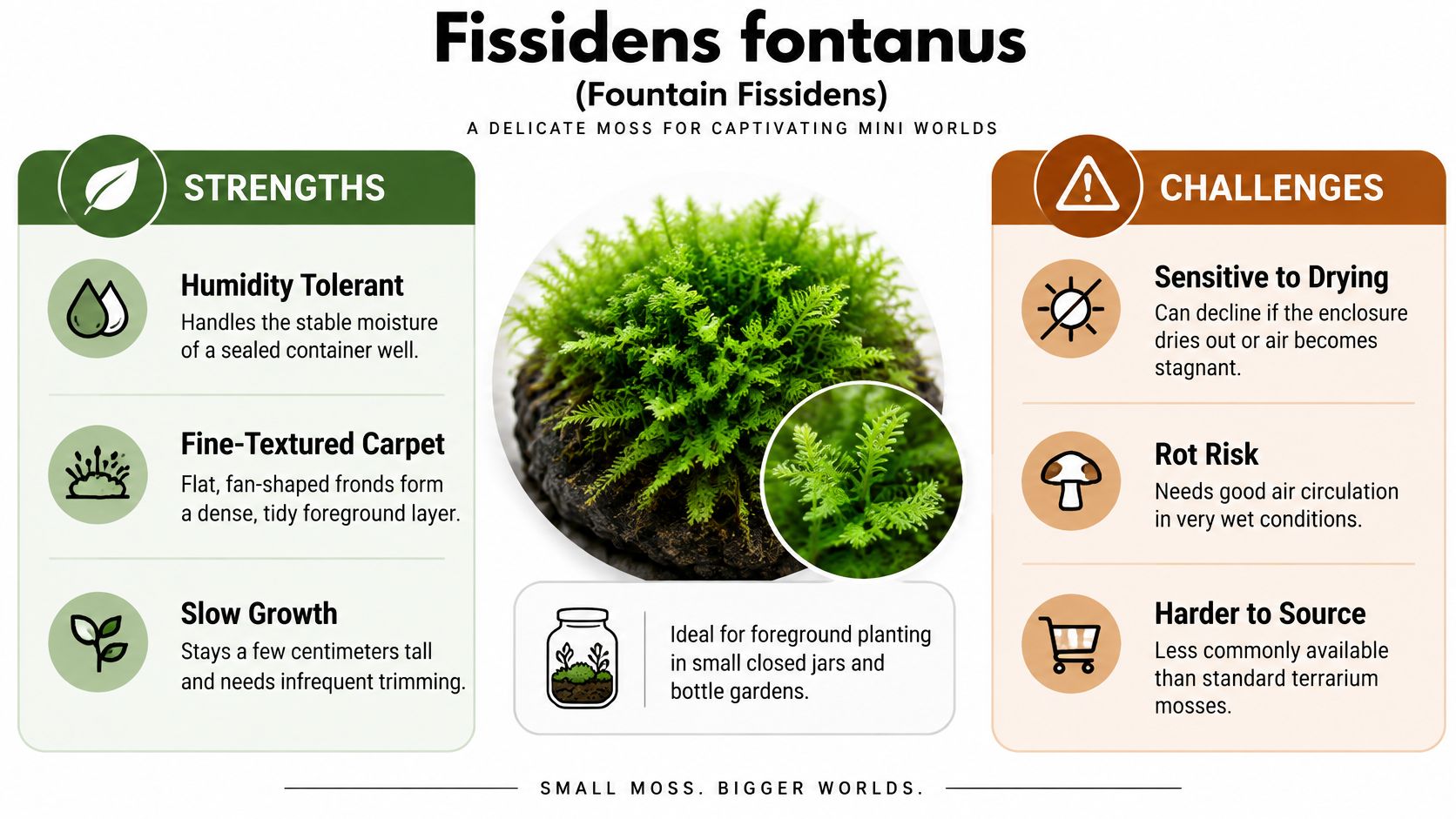
Give it a wet surface without flooding the jar
A useful layout is a small patch against a damp stone at the front of an enclosure, with other plants on raised substrate behind it. Keep the attachment loose enough that the shoots aren't crushed. Avoid burying the leafy growth beneath soil or wedging it into a stagnant puddle.
The University of Arizona Cooperative Extension terrarium guide explains that a hermetically sealed terrarium can recycle water continuously without additional watering, while an unsealed container loses moisture more slowly and needs infrequent watering. That distinction matters here: a closed lid doesn't create a reason to mist on schedule.
- Check the surface: Feel the growing medium before adding water, rather than using clear glass as proof of dryness.
- Watch new growth: Healthy new shoots are more useful evidence of adaptation than the condition of the original submerged foliage.
- Remove deterioration: Lift out loose, decaying material with fine tweezers instead of leaving it beneath the mat.
For broader planting and maintenance techniques, use the moss-growing guides on the Moss Keeping blog. I'd choose Fountain Fissidens for a controlled wet accent, not as the default moss for a beginner's entire jar.
2. Leucobryum glaucum (Pincushion Moss)
A rounded cushion can make a flat jar look like a natural scene. Pincushion Moss is a strong design choice for raised ground, where its pale green surface contrasts with dark stones, bark, and deeper-green foliage.
The trade-off is placement. A cushion perched on a moist, porous mound is a different proposition from the same cushion pressed into sodden soil. Its dense structure can retain moisture, so repeated spraying into the crown isn't a sensible response to every change in color.
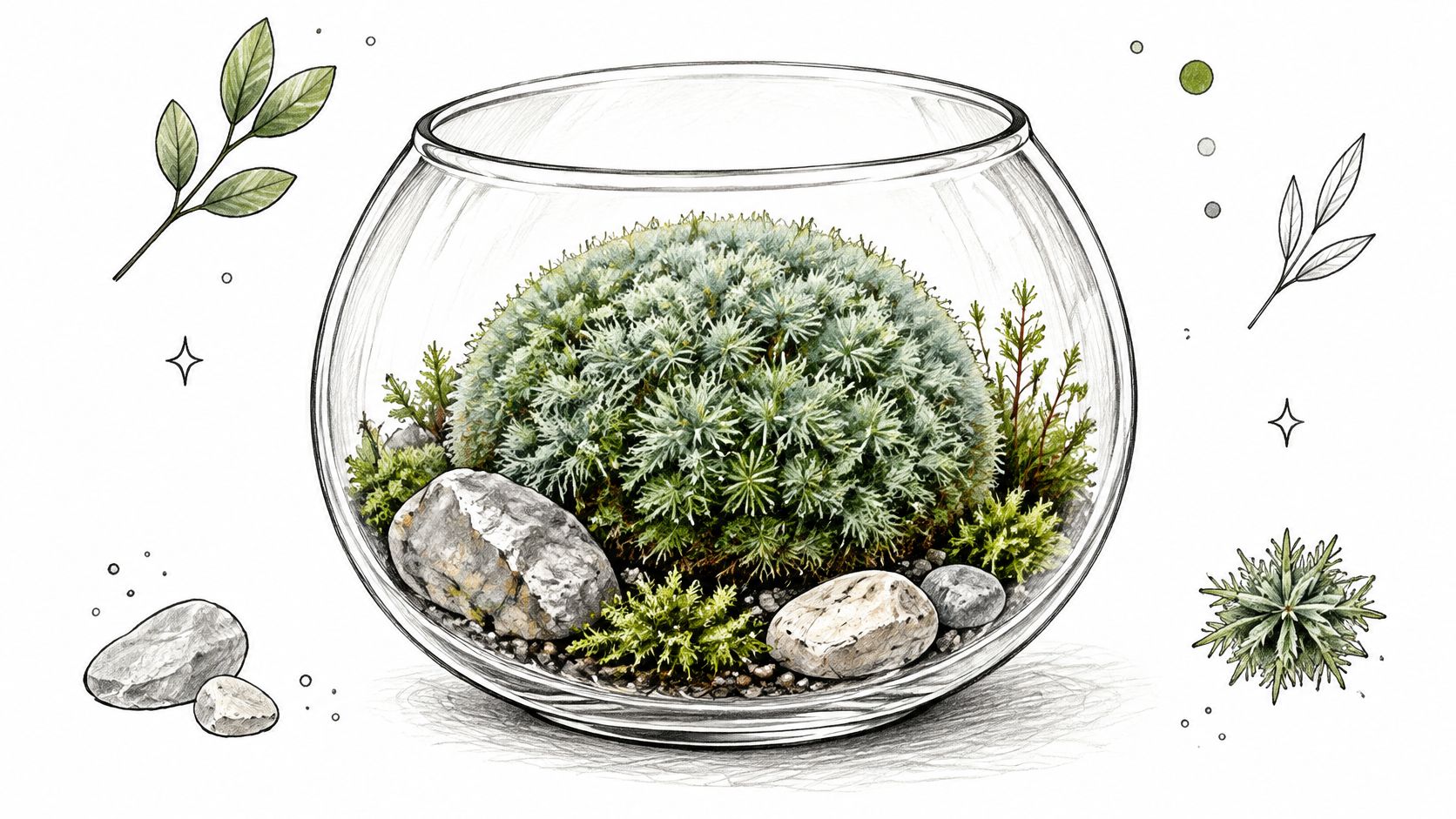
Keep the cushion above the wettest layer
Set the underside against damp substrate and leave the leafy crown exposed. Use curved tweezers to settle soil around the base without packing it over the top. If you're making a miniature rocky slope, place the cushion beside the stone rather than beneath a route where condensation repeatedly drips.
A controlled indoor moss cultivation study reported successful cushion-type moss growth around 20°C and approximately 6,000 lux. Those are cultivation conditions, not a guarantee for every Leucobryum glaucum specimen, but they're a useful reminder that a humid jar still needs suitable light and temperature.
Placement rule: Give the cushion humid air and a moist base, not a permanently soaked crown.
For a small glass terrarium, use a modest cushion as the main mound and leave visible substrate or stone around it. That open space makes it easier to notice spreading discoloration and prevents the composition from becoming crowded immediately.
Don't force a drying cycle because the surface looks pale. Inspect the texture and base first. Firm, pale growth isn't the same as soft, collapsing tissue, and adding water without checking can turn a manageable adjustment into rot.
3. Sphagnum palustre (Bog Moss)
Choose Bog Moss when you're deliberately building a bog-style enclosure. Its loose, branching growth gives a very different result from a close-cropped woodland carpet. It suits a design where visibly moist surfaces are part of the look, rather than something you're trying to hide.
Start by distinguishing living sphagnum from dried sphagnum used as growing material. Dried material can hold moisture, but you shouldn't buy it expecting an instant living carpet. For Sphagnum palustre, ask for correctly identified, living, cultivated material rather than an unspecified bag labeled sphagnum.
Build around its moisture needs
A practical use case is a dedicated bog scene with living sphagnum occupying the moist surface. If you add carnivorous plants, select them for their own light, temperature, and seasonal needs. A plant's association with bogs doesn't automatically make it suitable for a warm, permanently sealed jar.
Prepare the moss before planting:
- Inspect the material: Remove dead leaves, twigs, and visibly deteriorating sections with tweezers.
- Rinse gently: Use clean water to loosen debris, but don't mistake rinsing for sterilization.
- Control free water: Let excess water drain before placing the moss, rather than transferring a dripping handful into the enclosure.
Keep the growing tips exposed. Packing living sphagnum tightly beneath decorative moss or stones defeats the purpose of choosing it as a living surface.
The main trade-off is moisture separation. A bog-style patch and a raised woodland cushion may look appealing together, but a small jar gives you little room to maintain distinct conditions. If the whole substrate stays equally wet, you haven't created separate habitats by arranging different mosses on top.
I'd keep a first sphagnum build simple. Use it as the main living material, give it adequate light, and watch the growth tips rather than assuming its ability to hold water makes the enclosure self-correcting.
4. Hypnum cupressiforme (Cypress-leaved Plait Moss)
For a woodland floor, Cypress-leaved Plait Moss is a practical carpeting candidate. Its branching stems can soften the edge of a stone, cover exposed substrate, and connect separate parts of a layout without the sculpted look of cushion moss.
Its growth form is the main reason to consider it. A study of forest-floor bryophytes found that moisture responses differed between spreading pleurocarpous mosses and upright acrocarpous forms, supporting the practical distinction between carpets and cushions. That doesn't establish a universal performance ranking for Hypnum cupressiforme, but it helps you choose the right architecture.
Plant patches instead of a thick blanket
Say you're building a woodland jar with a dark stone at the back and a small fern off-center. Lay thin pieces of Hypnum across the foreground, letting the branching tips remain visible. Leave small gaps rather than folding excess material underneath to make everything look finished immediately.
A thick pad can conceal dead material and make it difficult to tell whether the lower layer is saturated. A thinner planting is easier to inspect and easier to remove if a section fails.
- Anchor lightly: Press the underside onto moist substrate without compressing the leafy surface.
- Keep edges accessible: Avoid stuffing moss tightly between the glass and a large stone.
- Trim selectively: Shorten shoots that cover neighboring plants, then collect the loose fragments.
The strongest beginner advantage is flexibility of placement. You can use a small patch as ground cover without committing the entire enclosure to a wet-growing specialty moss.
Still, don't treat the species name as proof that every purchased mat will behave identically. Ask how it was grown, whether it's alive rather than preserved, and whether the seller can confirm its identification. Healthy material already accustomed to humid shade is a better starting point than a beautiful but stressed mat.
5. Taxiphyllum barbieri (Java Moss)
Java Moss makes sense when your design includes damp wood or stone. Rather than pressing it into soil like a cushion, use its loose branching growth to soften a hard surface. It's especially useful when you want a humid, above-water planting near a wet zone.
Its familiarity as an aquarium moss can create the wrong expectation, though. Submerged growth and growth in humid air aren't interchangeable. Ask whether the stock has been grown emersed, and don't assume that closing the lid removes the need for acclimatization.
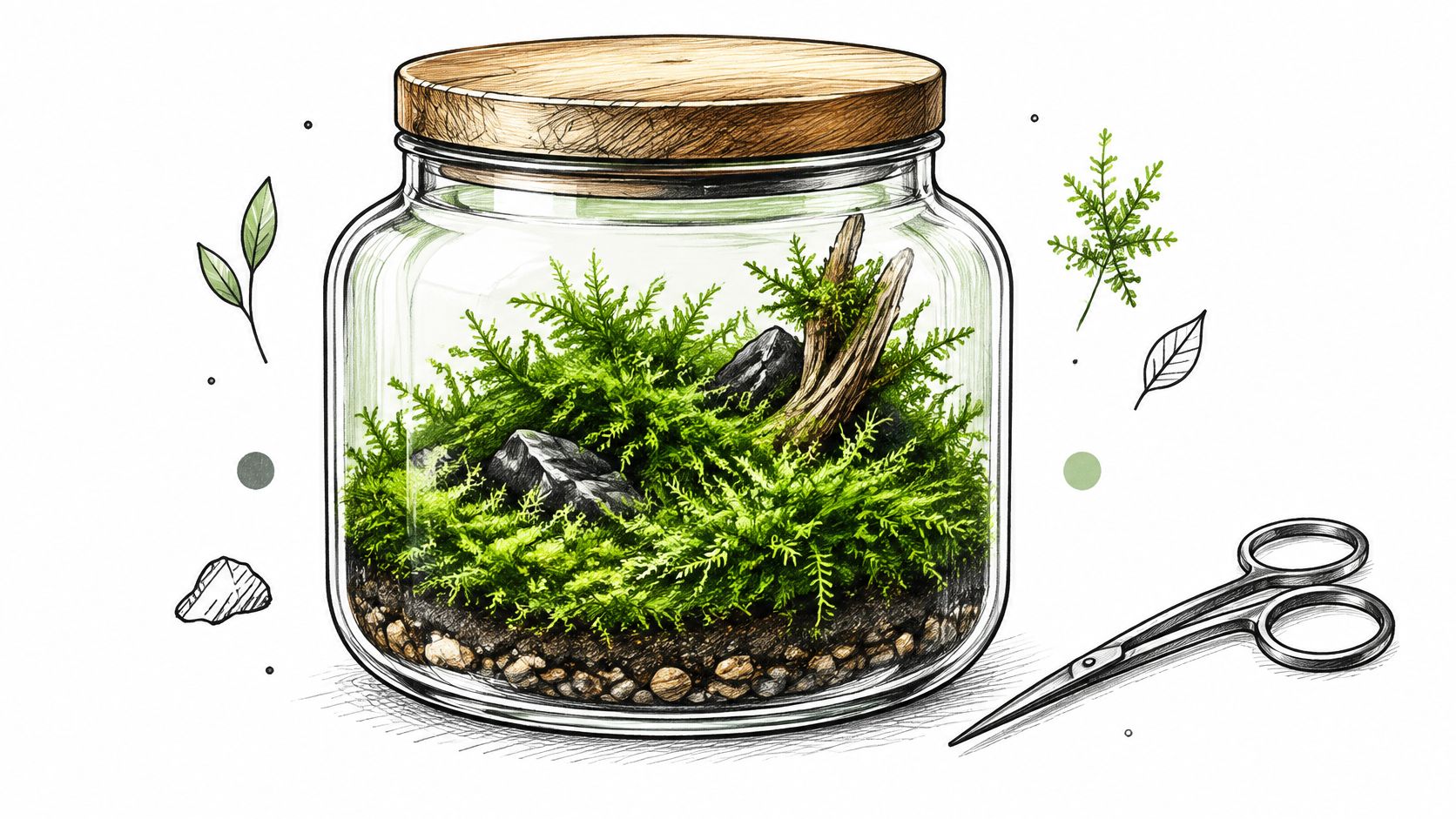
Use less than you think you need
For a typical layout, attach a thin portion along the upper surface of a damp branch. Use fine thread loosely enough to hold the moss without cutting through it, and keep the growing tips uncovered. A dense bundle may look lush at planting, but it makes the shaded interior harder to inspect.
A moss that tolerates wet conditions still needs light on its living shoots. Don't hide most of the plant inside a decorative bundle.
This makes Java Moss a more manageable choice in an accessible tank than in a narrow-neck bottle. You'll want room to reach it with scissors, lift out loose pieces, and check the attachment point.
Before planting, rinse the material and inspect it against a pale tray for debris and unwanted hitchhikers. Rinsing can dislodge organisms, but it doesn't guarantee that none remain.
The maintenance trade-off is untidy growth. If shoots start obscuring the hardscape or neighboring plants, trim them before they form a tangled mass. Remove the cuttings with tweezers rather than letting them settle into wet pockets.
Dispose of unwanted material in contained household waste where appropriate. Never release moss, aquarium water, or trimmings into outdoor waterways, drains leading to natural water, or garden ponds.
6. Thuidium delicatulum (Fern Moss)
Fern Moss is the choice for a roomier woodland scene with visible branching detail. Its fern-like shoots create a miniature forest-floor effect, particularly beside a small fern, weathered bark, or an irregular stone.
That detail needs space. In a tiny jar, pressing the branches against the glass can flatten the very texture you bought it for. Choose it when the enclosure has enough floor area and headroom to display the shoots without compressing them.
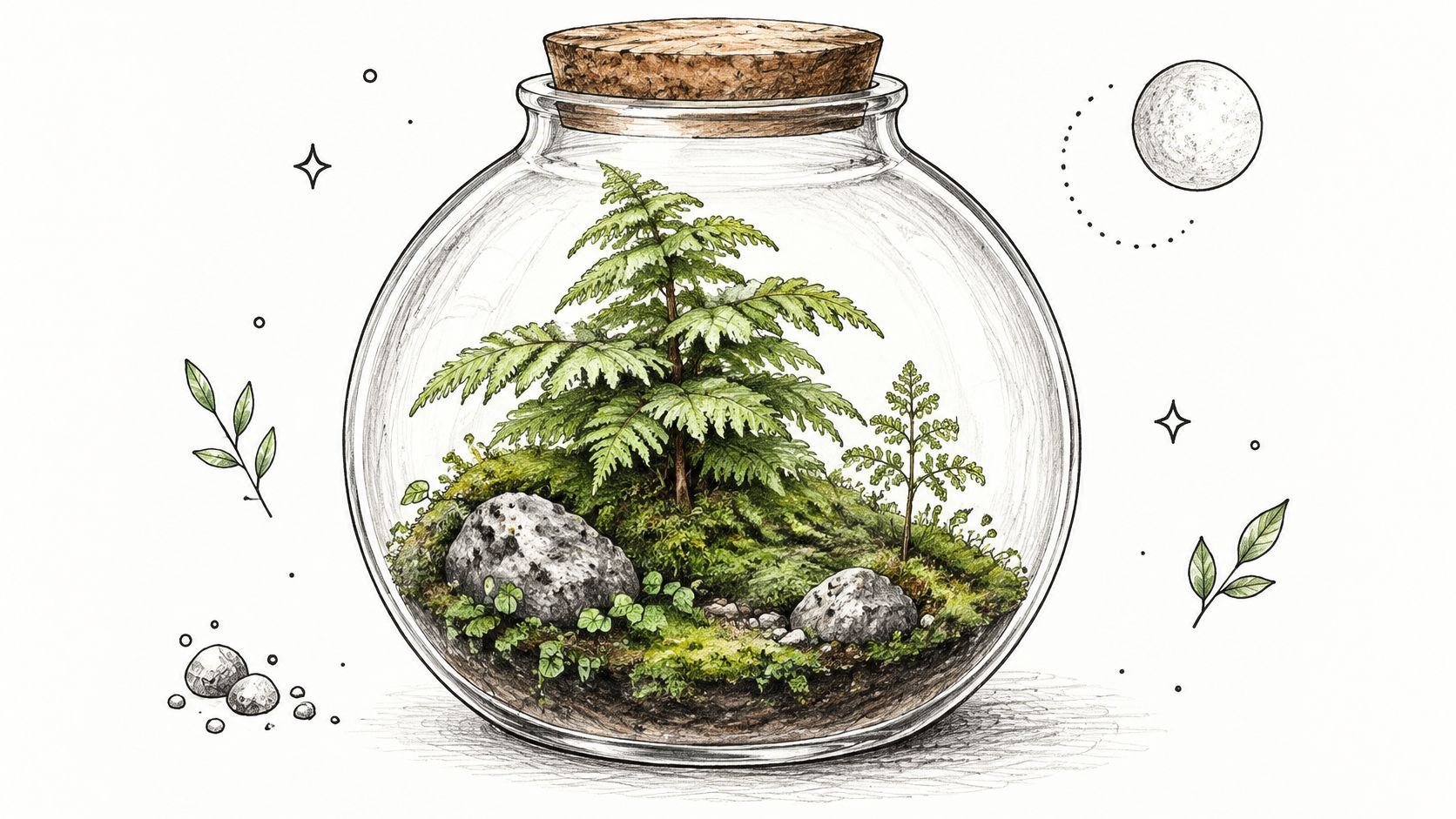
Protect the structure during planting
Lift each piece from beneath with broad tweezers or a small spatula. Support the mat as you position it, then settle the underside onto moist substrate. Repeatedly pinching the branch tips makes planting harder and can damage the display.
The University of Maryland Extension guide to landscape moss associates moss growth with consistent moisture, shade, and low fertility. Those are useful habitat clues, not a reason to keep a terrarium dark or to assume every woodland moss will accept a warm sealed enclosure.
For a practical arrangement, place Fern Moss across a shallow raised bank, with a clear strip of stone separating it from the glass. You can inspect the edge without disturbing the main planting, and fallen leaves won't disappear so easily beneath it.
- Preserve headroom: Keep taller companion foliage from pressing down on the branches.
- Remove litter: Pick out fallen fern leaves before they decay inside the mat.
- Correct excess moisture: If the enclosure remains heavily fogged and the moss deteriorates, open it and assess the substrate rather than adding more spray.
Humidity and ventilation aren't opposing goals. You can maintain humid conditions while opening an over-wet jar to correct the balance. A lid is a management tool, not a promise that you'll never need to intervene.
7. Rhodobryum roseum (Rose Moss)
Choose Rose Moss for its upright shoots and rosette-like leaf clusters, not because you expect a red carpet. Its growth creates an accent that reads differently from both a spreading mat and a rounded cushion.
It deserves a cautious recommendation rather than a claim that it's universally forgiving. Provenance, previous growing conditions, and the enclosure's temperature matter. A specimen from a cool, shaded setting shouldn't automatically be treated as a tropical plant because it fits inside glass.
Give the rosettes room to stand
A useful design is a raised accent patch behind a low carpet, with the upper leaves clearly visible. Leave room around the shoots rather than packing their bases with other moss. In a small jar, fewer well-positioned shoots usually show the form better than a crowded clump.
A comparative study of moss water relations found that water-holding and water-retention capacity were positively related, while photosynthetic responses varied among species. The practical lesson is not to transfer watering assumptions from one moss to another, even when they share an enclosure.
Watch the base as well as the upper leaves. A green-looking crown doesn't justify ignoring softened, darkened tissue below it, particularly where wet substrate touches the stem.
Design judgment: Use Rose Moss as a feature you can inspect and remove easily, not as an untested foundation beneath the rest of the planting.
For maintenance, lift out fallen debris with fine tweezers and thin crowded shoots selectively. Avoid repeatedly shearing across the tops as though you're trimming a lawn, because the upright form is the reason to grow it.
Provide bright, indirect light, but don't increase direct sun exposure to chase reddish coloration. Healthy structure and fresh growth are better targets than a particular color. If the plant steadily declines despite suitable moisture and lighting, reassess the habitat match instead of trying to rescue it with more water.
How the Seven Closed Terrarium Mosses Compare
| Item | Humidity Preference | Light Tolerance | Growth Rate | Best For |
|---|---|---|---|---|
| Fissidens fontanus (Fountain Fissidens) | Consistently humid | Low to moderate indirect light | Slow | Fine-textured foreground carpets in closed terrariums |
| Leucobryum glaucum (Pincushion Moss) | Moist; avoid constant sogginess | Moderate indirect light; bright indirect light helps maintain color | Slow | Sculptural cushion accents and focal points |
| Sphagnum palustre (Bog Moss) | Wet, cool conditions | Not specified | Not specified | Moisture buffering in bog-style and sealed terrariums |
| Hypnum cupressiforme (Cypress-leaved Plait Moss) | Adaptable to varied humidity | Adaptable to varied light | Spreads readily | Hardy ground cover for woodland terrariums |
| Taxiphyllum barbieri (Java Moss) | Humid or wet conditions | Low to moderate light | Fast | Quick coverage in terrariums, vivariums, and aquascapes |
| Thuidium delicatulum (Fern Moss) | High, steady humidity | Moderate indirect or filtered light | Not specified | Miniature forest scenes and textured layouts |
| Rhodobryum roseum (Rose Moss) | Moderate humidity | Indirect light; bright indirect light helps maintain color | Not specified | Colorful accents and layered moss displays |
Matching Your Moss to Your Sealed Glass Setup
Return to that fogged jar with browning moss. The first question isn't which replacement species looks better. It's whether the existing moss is struggling with insufficient light, excess water, unsuitable temperature, or a difficult transition from its previous growing conditions.
Start with light, because sealing a jar doesn't compensate for darkness. The University of Arizona Extension terrarium guidance warns that typical indoor light can be insufficient and recommends a suitable window position or artificial lighting. Keep the enclosure out of direct sun, and use a grow light if your intended shelf is too dim.
Match the habitat before the appearance
Choose your moss according to the surface it will occupy, not just the humidity you expect under the lid. Humid air, moist substrate, and standing water are different conditions.
- For a woodland carpet: Start with healthy, correctly identified Hypnum material accustomed to humid conditions.
- For a raised mound: Consider Pincushion Moss, keeping its crown exposed and its base out of saturated pockets.
- For a deliberate wet feature: Trial emersed Java Moss or Fountain Fissidens on a suitable surface.
- For a bog-style build: Let living sphagnum define the planting conditions instead of squeezing it into an incompatible mixed layout.
- For a larger scene: Give Fern Moss or Rose Moss enough space to retain their distinctive structure.
For a first build, I'd favor a modest Hypnum planting over a complicated mix of aquatic, bog, and woodland mosses. You'll have fewer competing requirements to interpret, and you can inspect the substrate without dismantling the whole scene.
Watch the enclosure before adding water
During the initial settling-in period, check condensation, substrate moisture, and the moss itself regularly. Some condensation is useful context, but neither fogged glass nor clear glass tells the whole story. Look for firm shoots, healthy new growth, and the absence of soft, collapsing patches.
Trim early when growth starts crowding neighboring plants, and remove every loose cutting you can reach. If the substrate is saturated, open the jar and let excess moisture escape rather than treating every brown patch as thirst.
Build a small test jar before committing to the full display. Use the same substrate, lighting position, and moss you intend to use in the larger enclosure, then wait for convincing new growth. That gives you a practical answer to the question that matters most: whether this moss suits your actual setup.
Moss Keeping offers practical guides to growing moss and building moss terrariums at home. Visit Moss Keeping to plan your substrate, refine your watering routine, and turn a small test jar into a healthy sealed display.