How to Water a Moss Terrarium Without Flooding It
Learn how to water a moss terrarium by reading condensation, misting lightly, and skipping the soak that rots moss.
Forget the weekly spray routine you've probably seen repeated everywhere. That's the advice that floods most moss jars, not the advice that keeps them alive. If you're learning how to water a moss terrarium, your best tool isn't a calendar or a measuring cup. It's the condensation on the glass, and it will tell you to leave the bottle alone far more often than you expect.
Check Moisture Before You Add Any Water
Weekly watering kills more closed moss jars than neglect does. Moss doesn't need you to keep it continuously wet. It needs you to restore slight moisture only when the jar has dried, then stop.
Match what you see today to one row before you open anything.
| What you see | Moisture reading | What to do |
|---|---|---|
| Light condensation and dark damp moss | Balanced humidity | Do not water |
| No condensation and dry pale moss | Too dry | Fine mist, then recheck in 24-48 hours |
| Heavy droplets or soggy substrate | Too wet | Ventilate and withhold water |
| Standing water in the base | Saturated | Wick it out, then air briefly |
| Closed jar staying lightly dewed for months | Self-watering cycle | Leave it and check every few months |
Read each row literally
Light condensation plus dark, damp substrate means the cycle is working. Don't add water because you feel you should. The moss is already getting moisture back from the air inside.
No condensation and dry, pale moss is the only clear watering signal in the table. Even then, the answer is a fine mist, not a pour. You're topping up humidity, not filling the base.
Heavy droplets that persist, soggy soil, or water sitting in the bottom means you've passed damp and reached saturated. Adding more won't help the moss drink faster. It removes air from around the leaves and substrate, which is where rot starts.
If the glass is already dewed and the substrate looks dark, close the lid and walk away. That restraint is the watering decision.
Why the jar mostly waters itself
A closed terrarium runs a small water cycle. Moisture evaporates from the growing medium, humidity rises inside the container, water condenses on the glass or lid, and droplets return to the substrate.
That cycle explains the long gaps between drinks. The University of Arizona terrarium guide explains that an airtight terrarium can cycle water continuously and require no additional watering, while a closed but non-airtight container dries gradually and needs occasional replenishment. The same source notes Iowa State University Extension reports that many closed terrariums need water only every 3 to 6 months, although the interval varies with soil type, plant species, light level, and enclosure design.
Read that interval as permission to wait, not as a deadline. A tight seal, cool room, and moisture holding substrate stretch the gap. A loose lid, bright light, and thin substrate shorten it.
Purdue University guidance quoted in that guide fits the same pattern. Moisten evenly with a fine mist until water begins to seep through, and don't leave standing water at the bottom. You're aiming for even dampness, not a reservoir.
So start every check the same way. Look at the glass, look at the color of the substrate, look at whether the moss looks expanded or shrunken and pale. Trust that combination over a reminder on your phone.
How to Water a Moss Terrarium
Once you've decided the jar is dry, use a mist-and-observe routine. Small dose, lid back on, then wait. The waiting is part of the method, not an afterthought.
Prepare the water first
Fill a clean sprayer with distilled, collected rain, or reverse-osmosis water. Minerals in hard tap water crust the glass and sit on moss leaves, and you can't rinse them out of a closed jar easily.
If tap water is your only option, let it stand uncovered so chlorine fades before you use it. Skip water from a softener. Use this same clean water for every step, whether you're misting or dosing with a syringe.
The mist-and-observe steps
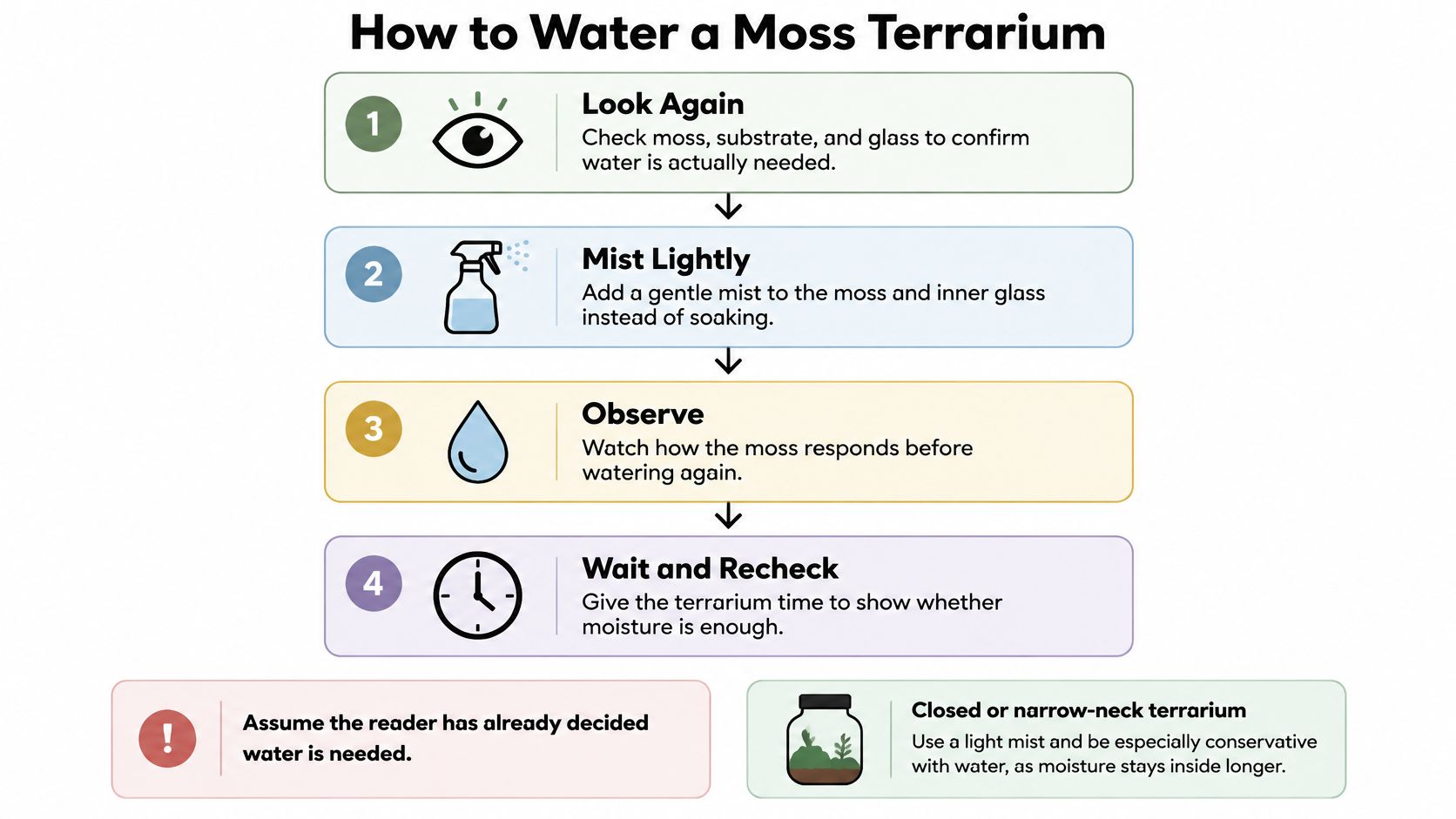
- Look again before you spray. Check moss, substrate, and glass one more time, because if the medium is still moist and condensation is light, you don't need water today.
- Mist the moss and inside glass lightly. Use a fine spray until the surface darkens and looks evenly damp, then stop before beads run together and pool, because pooled water fills air spaces the moss needs.
- Switch tools for a narrow neck. Use a syringe or pipette to place small doses on dry patches and the inner glass, because a spray bottle through a tight opening splashes walls and dumps too much in one spot.
- Close the lid. Sealing the jar lets humidity spread evenly, so dry corners can recover from moist air rather than needing a second direct hit.
- Wait 24 to 48 hours before judging. The Royal Horticultural Society terrarium advice recommends sparse misting followed by delayed reassessment rather than repeated immediate watering, and notes closed or narrow-neck terrariums commonly need watering only a few times per year.
- Read the glass at the recheck. Light condensation means the dose was right, so hold. Heavy droplets that won't clear mean you added too much, so crack the lid until they thin, then close it again.
- Remove any pool instead of diluting it. Wick standing water out with a clean paper towel corner or cotton swab, because you can't drain a sealed jar and spraying again only deepens the problem.
Stop point: Quit misting when moisture just starts to seep through the moss. If you can see water collecting, you've already gone one spray too far.
Why there's no milliliter target
Don't look for a universal amount. Jar volume, substrate depth, lid seal, temperature, light, and moss species all change how fast water evaporates and how much the medium holds. A dose that's perfect for a large, deep jar will saturate a small, shallow one.
A pour makes that worse. It rushes to the base, leaves some patches dry on top, and is hard to undo. Mist and measured drops let you stop at damp.
By the next day, success looks specific. The moss looks expanded rather than curled tight. The substrate is dark but not glossy. The glass carries only a light film, not rivulets. If you see that picture, don't reward it with another spray.
Set the Interval and Check Again
Your container sets the starting interval. Your room then moves it, so two identical jars in the same house can end up needing water months apart.
| Container | Typical interval | What to do |
|---|---|---|
| Airtight closed jar | No added water needed | Leave alone and read the condensation |
| Closed, not fully sealed jar | Every 3 to 6 months | Give a small measured drink |
| Open dish or lid-off bowl | No fixed schedule; mist when the glass stays clear | Mist lightly, then recheck |
An airtight jar recycles its own moisture, so your job is mostly inspection. A loose lid leaks humidity slowly, which is why it earns an occasional top-up rather than a routine one. An open dish loses moisture straight to room air, heaters, and air conditioning. It dries on a completely different clock, and the glass tells you when that clock has run out.
Don't panic if the moss looks less vibrant during a dry stretch between checks. A 2023 peer-reviewed study on the dryland moss Syntrichia reports that many bryophytes tolerate desiccation by suspending metabolism while dry and rapidly resuming photosynthesis and growth after moisture returns. Mississippi State University Extension guidance in that research also cautions against fully saturating the substrate, because water can be added later but cannot easily be drained from a closed container. Dull, dry moss is often dormant. Flooded moss is often rotting.
Write the mist date on a small piece of tape on the base, plus a one line note such as light dew next day or heavy droplets, aired. That record stops you watering from worry when you can't remember the last dose, and it pairs well with broader habits for keeping moss alive indoors.
Set each recheck by the jar's conditions. A calendar can't see condensation. A desk jar beside a winter heater deserves a glance every couple of weeks, while a cool, sealed jar in the same room may sit untouched far longer.
Fix Too Much or Too Little Water
Saturation does damage slowly and then all at once. Waterlogged substrate loses its air spaces, microbes multiply, and moss that looked fine while wet collapses into sludge. The fixes below remove water or add air. None of them starts with another spray.
| Sign | What it means | What to do |
|---|---|---|
| Persistent heavy condensation | Excess moisture trapped | Vent the lid briefly, as after misting |
| Pool or sour smell at the base | Anaerobic saturated substrate | Blot out the water and ventilate, as after watering |
| Moss turning to dark sludge | Prolonged saturation and microbes | Remove rotten parts and dry toward damp |
| White crust on glass or moss | Mineral-heavy tap water | Switch to distilled or rain and wipe |
| Green film on the glass | Wet surfaces plus strong light | Reduce light, clean glass, ventilate |
| Growth stalled while still wet | Water film limiting gas exchange | Let the surface dry back to damp |
Work through the wet signs first
Persistent heavy condensation means the jar holds more water than it can cycle. Condensation works like a fuel gauge for moisture, and thick droplets that stay for days are a needle pinned to full. Respond the same way you did right after misting: crack the lid until the glass clears to a light film, then close it and watch for a day.
A pool or sour smell at the base means the substrate has gone anaerobic. The air spaces filled with water, and the microbes living there switched to a sour-smelling chemistry. Blot the standing water out with a paper towel the same way you did after watering, leave the lid off briefly, and never reseal a jar that still drips. Smell is useful information. A healthy jar smells earthy. Sour or stagnant means the base has stayed flooded too long.
Dark sludge means that patch stayed saturated too long. Lift out the rotten material so decay stops spreading to living moss, then let the rest dry back to damp. Tissue that has already broken down stays dead no matter how wet you keep it.
The wet but stalled jar
The confusing case is moss that stops growing while everything still looks wet. Misting again is the natural reaction, and it makes the problem worse.
Moss carries a thin capillary film of water on its surfaces. Field research on bryophyte hydration found that this film slows water loss, and the same film can obstruct carbon-dioxide diffusion. In plain terms, a leaf wrapped in a constant film of water exchanges gases poorly, so photosynthesis stalls in a jar that looks perfectly moist.
The same research found that species often remain hydrated well below their maximum water-holding capacity. The target is humid air and damp surfaces with occasional ventilation, well short of soaking.
Judge four things separately: leaf surface moisture, substrate color, condensation, and airflow. A jar can score wet on the first three and still be suffocating on the fourth.
When the jar has dried out
Too little water calls for restraint of a different kind. Moss that has gone brown, crisp, and shrunken has usually gone dormant, since many mosses survive drying by pausing growth and waiting for moisture to return. Give the colony and substrate one light, even mist until damp, then leave it alone. The gradual recovery test below shows how regreening moss differs from dead tissue, so hold off on a second soaking until you have run it.
Crust, film, and the room around the jar
A white crust on glass or leaves usually comes from minerals left behind as tap water evaporates. Switch to distilled or rainwater and wipe the film from the glass so light reaches the moss evenly.
A green film means wet glass is getting strong light. Ease the light, clean the inside wall with a soft swab, and give the jar a short airing. Algae thrives on the same constantly wet, bright surface you are trying to move away from.
Fix the room as well as the water. Indoor heating and air conditioning change how the same volume of water behaves. A jar near a vent can dry at the surface while staying soggy at the base, which fools you into misting a jar that needs airing and a new spot.
Wait Out Brown Moss Before Calling It Dead
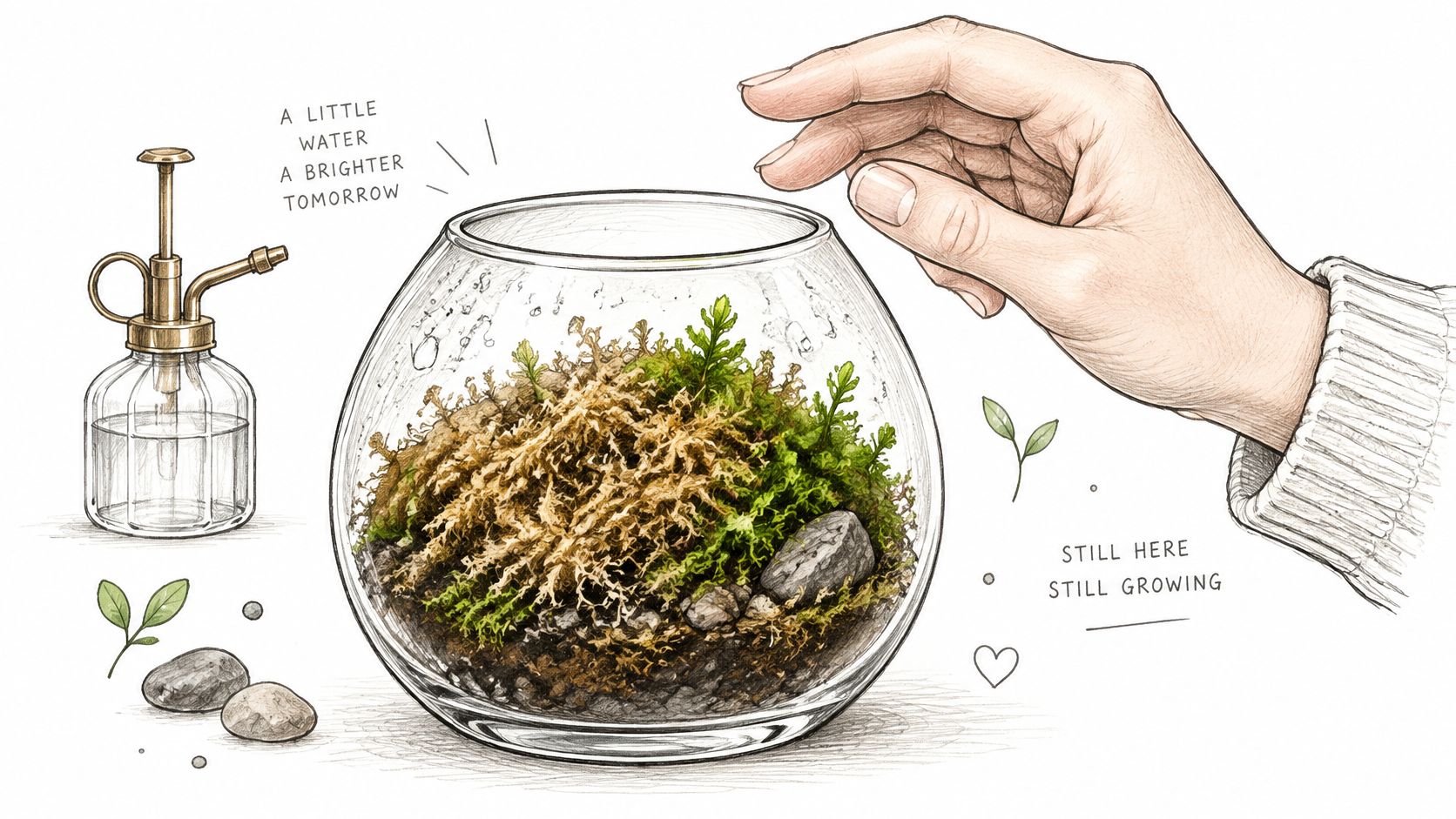
Brown moss is often dormant, not dead. Many mosses are desiccation tolerant: they dry, shut down, and wait for moisture to return. A shrunken, crispy clump can sit in that suspended state for a long time, so the right response is one measured mist and a day of patience.
Run a gradual recovery test
Mist the colony and substrate lightly until evenly damp. Close or partly close the jar to hold humidity, keep it out of strong light, and watch for several hours. Don't add a second soaking because the first ten minutes didn't transform it.
A light film of condensation on the glass afterward tells you the jar is holding the humidity the test needs. Dry glass means the lid needs adjusting.
Look for small changes. Color may deepen from pale brown toward green. Leaves may uncurl and the clump may expand. Texture matters too: dormant moss that's recovering feels like it's reopening, while dead tissue stays limp, brittle in a lifeless way, or turns mushy.
Recovery inside the tissue can be surprisingly fast. A University of Waikato research record on bryophyte rehydration reports that in one experimentally studied moss, relative water content recovered to above 90% within 10 minutes of rehydration after falling below 2% during four hours of drying. Visible recovery of a whole clump in a jar is slower than that tissue level uptake, which is why your checkpoint is hours, not minutes.
Set two checkpoints, not ten sprays
- After several hours: Check the same patch under the same light, because changing light changes how green or brown moss looks and can fool you.
- The next day: Assess the patch in that same light before deciding it needs more water, because expansion and color return can lag behind the initial uptake.
Let the checking routine you already use for the jar's watering interval carry this recovery watch too. A noted time and a clear timeline break the anxious loop of mist, glance, mist again.
Don't judge color from a glance right after misting. Wet tissue looks darker than it will once the surface settles, so a just sprayed patch can look revived when it's only wet.
Waiting rule: One thorough mist, high humidity, and a full day of observation tell you more than five soakings in one afternoon.
Know when a patch is lost
Tolerance varies by species, tissue condition, temperature, light, and how long the moss stayed dry. A patch that was already damaged before it dried has less to recover with, and no amount of soaking rebuilds broken tissue.
Continuous soaking after a hard dry spell doesn't speed recovery. It leaves the jar airless and invites the same rot you'd get from chronic overwatering. Rehydration needs moisture and humidity, not submersion.
If nothing changes after a thorough mist, a humid closed jar, and a full day, treat that patch as lost. Remove it, keep the still living moss only damp, and don't punish the survivors with extra water meant for the dead patch. Never seal a dripping wet jar in strong light while you wait, because heat, saturation, and low gas exchange combine into exactly the conditions that finish weakened moss off.
If you want to get better at reading condensation, choosing water, and reviving dry moss without flooding it, Moss Keeping offers practical guides to growing moss and building moss terrariums at home. Visit Moss Keeping to keep learning the small, patient habits that keep a jar balanced for months.